Pure Pursuit Steering & Speed Control: Adding Extension Modules onto Plain PP
The runtime tracking controller that turns the raceline from global planning into actual steering/speed commands. With geometric Pure Pursuit as the skeleton, it stacks adaptive lookahead, understeer, heading PID, and friction-circle speed control on top to hold the line even at high speed. (controller package · pp_node)
Stack position: perception → tracking → prediction → planning → state machine → control (Pure Pursuit)
① Principle
The tracker is agnostic to where the path comes from — it follows the global raceline normally, and an avoidance spline when there is an obstacle, in exactly the same way.
flowchart LR
    G["global raceline"] --> SM["state_machine"]
    O["avoidance spline"] --> SM
    SM -->|/local_waypoints| PP["Pure Pursuit (50Hz)"]
    PP -->|/ackermann_cmd| V["vehicle"]
Core: Geometric Pure Pursuit
Pick a target point a fixed distance ahead ( $l_d$ ) on the path, and compute the steering angle that traces an arc through that point.
\[\kappa_{pp} = \frac{2\, l_y}{l_d^{2}}, \qquad \delta_{geo} = \arctan(L\cdot \kappa_{pp})\]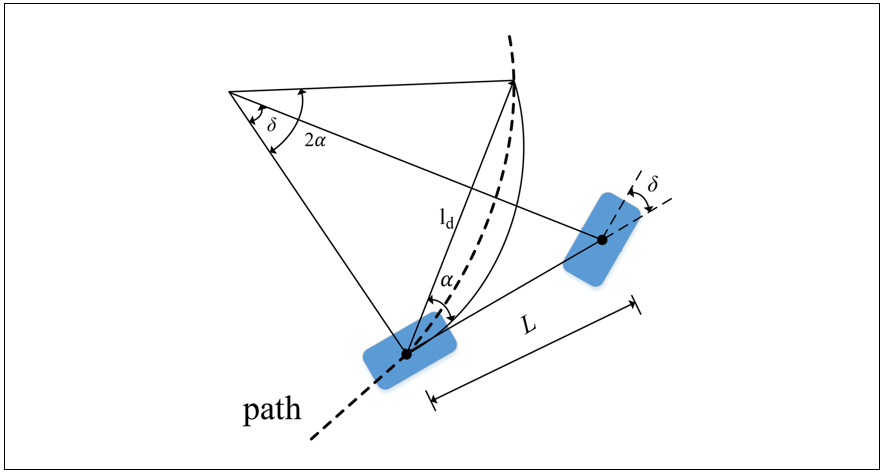
Extension Modules
Module 1 — Adaptive Lookahead: a fixed lookahead can’t satisfy low and high speed at once → make it proportional to speed (time-headway).
\[l_d = \mathrm{clip}(t_{hw}\cdot v_x,\ l_{d,\min},\ l_{d,\max})\]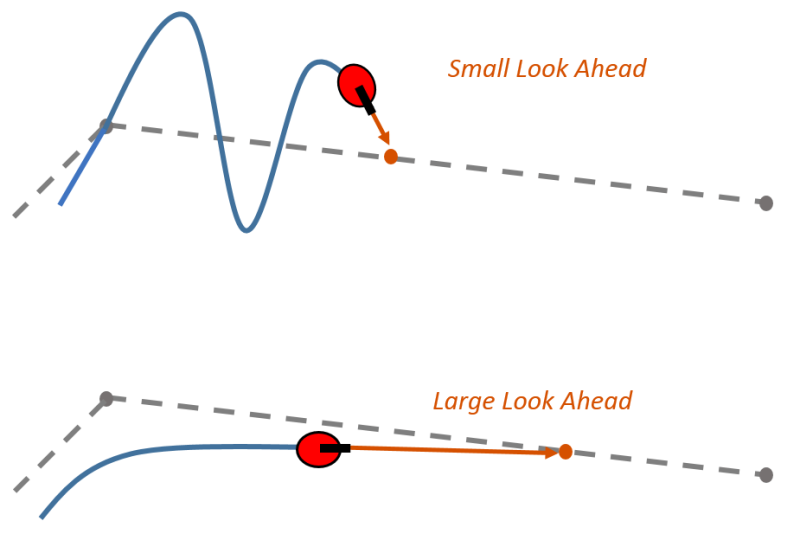
| Parameter | Value | Meaning |
|---|---|---|
t_headway | 0.3 s | how far ahead (in time) to look |
ld_min / ld_max | 0.6 / 2.5 m | lookahead lower/upper bound |
Module 2 — Understeer Feedforward: pre-compensate for high-speed corner understeer. $\delta_{us}=k_{us}\,a_{lat}$ ( k_understeer=0.010 ).
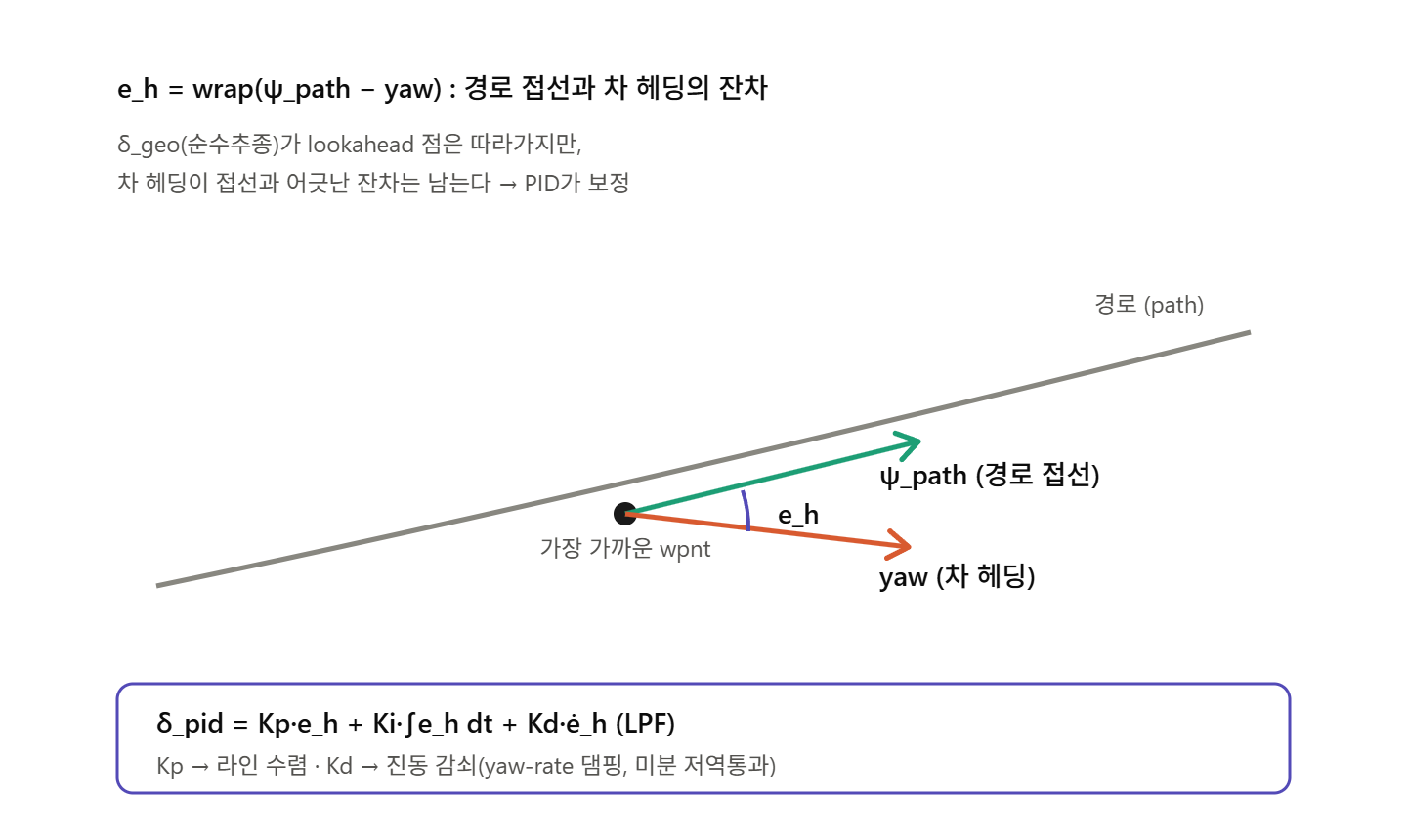
Module 3 — Residual Heading PID: PID-correct only the heading error $e_h$ that pure pursuit leaves behind ( Kp/Ki/Kd=0.4/0/0.05 ).
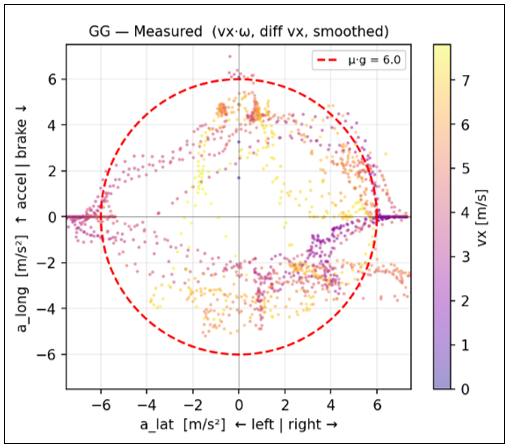
Module 4 — Friction-Circle Speed/Accel Control: distribute the total grip $a_{total}$ into lateral/longitudinal + predictive braking + a heading-aligned acceleration gate.
\[a_{long} = \min(a_{long,\max},\ \sqrt{a_{total,\max}^2 - a_{lat,ref}^2})\]The friction circle appears in both global planning (offline, shaping the line via the ggv) and Pure Pursuit (runtime, clamped every 50Hz) — the timing and target differ. The controller’s friction circle is a real-time safeguard regardless of the current path.
② Running It (RoboStack)
Runs in the RoboStack conda env (
unicorn) with no system ROS. Same setup procedure as the Centerline page.
1
2
3
4
5
unicorn                    # = source unicorn.sh (conda env + CycloneDDS + workspace)
cbuild                     # colcon build + re-source
# full autonomy (perception → tracking → prediction → planning → state machine → control) + virtual opponent
ros2 launch stack_master headtohead.launch.xml sim:=true map:=f
# Pure Pursuit alone: ros2 run controller pp_node   (or stack_master/ppc.launch.xml)
Package/node:
controller·pp_nodeSubscribes:
/car_state/odom,/local_waypoints(output of state_machine)Publishes:
/vesc/high_level/ackermann_cmd(steering + speed),/pp/lookahead(RViz)
③ Results
The actual screen of Pure Pursuit following the raceline in simulation:
Whatever the path (global raceline or avoidance spline), it is handled as the same tracking problem — fast driving and safe detours with one controller.
Wrap-up
Pure Pursuit is a geometric controller that produces steering as an arc toward a look-ahead target on the raceline; on top of it, four modules — adaptive lookahead · understeer FF · residual heading PID · friction-circle speed control — keep the line stable even at high speed.
- Handles any path source (global raceline / avoidance spline) as the same tracking problem
- The friction circle clamps speed/accel in real time every 50Hz for safety
The global raceline it follows is produced by Global Trajectory Optimization, and the predictions behind opponent avoidance come from Gaussian Process trajectory prediction.